Mogadishu, Somalia — October 2026: The Somali Media Women Association (SOMWA) is implementing a national mapping of women journalists across Somalia to establish a comprehensive and verified picture of women working in the country’s media sector.
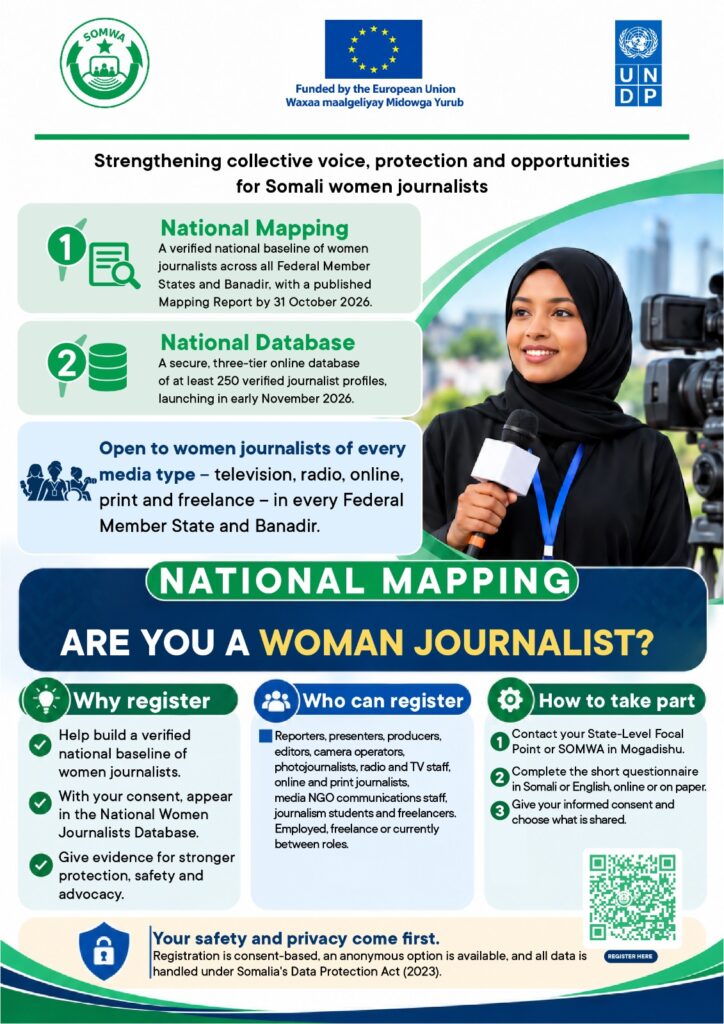
The initiative, supported by the United Nations Development Programme (UNDP) and funded by the European Union (EU), within the Bilan Media project, aims to identify and document women journalists working across all Federal Member States and Banadir, while examining their professional experiences, working environments, opportunities and challenges.
The mapping is part of SOMWA’s efforts to strengthen the collective voice, protection and opportunities of Somali women journalists and to promote greater inclusion of women in Somalia’s media sector.
The exercise will collect information on women journalists working across different media platforms, including television, radio, print, online and digital media. It will also seek to understand the geographic distribution of women journalists, their professional roles, access to opportunities and training, and the barriers affecting their participation and advancement in journalism.
SOMWA will work with women journalists and media stakeholders across the country to ensure that the mapping reflects the diversity of Somalia’s media landscape. The process will cover all Federal Member States and Banadir, helping to address existing gaps in reliable data on women working in journalism.
“For many years, women journalists have played an important role in informing the public and telling the stories of their communities, yet there has been limited reliable national data showing who they are, where they work and the challenges they face,” said Maryan Seylac, Executive Director of SOMWA. “This mapping will help us build a stronger evidence base for programmes, policies and interventions that respond to the realities of women journalists across Somalia.”
Secure national database to preserve the mapping data
Following the completion of the national mapping, the information collected will be consolidated into a secure national database of Somali women journalists. The database will be designed with a three-tier access system to ensure that information is managed responsibly and that access is granted according to defined roles and permissions.
The three-tier structure will help distinguish between different levels of access, allowing authorised users to access only the information necessary for their specific responsibilities. This approach is intended to strengthen data security, privacy and responsible management of information concerning women journalists.
The database will provide a sustainable resource that can be updated over time, helping SOMWA and relevant stakeholders maintain a more accurate and current understanding of women’s participation in Somalia’s media sector. It will also support future research, programme planning, advocacy and targeted interventions.
The mapping is expected to produce a verified national baseline of women journalists, followed by a national mapping report. Together with the secure database, these outputs will provide a national reference point for media organisations, government institutions, development partners, civil society organisations and other stakeholders working on media development, women’s participation, protection and gender equality.
The initiative also comes at a time when Somali women journalists continue to contribute to public information and accountability while working in a challenging media environment. Reliable and responsibly managed data can help stakeholders better understand the specific needs of women journalists and design more targeted support.
SOMWA is encouraging women journalists from all media types and across all Federal Member States and Banadir to participate in the mapping. Broad participation will be essential to ensuring that the final findings accurately represent women working in Somalia’s diverse media sector.
The national mapping is being implemented by SOMWA with the support of UNDP and funded by the European Union, within the Bilan Media project, as part of broader efforts to strengthen inclusive institutions, support women’s participation and promote a more resilient media sector in Somalia.
The final mapping report and secure database will provide a foundation for future programmes, advocacy, research and policy discussions concerning women journalists in Somalia.