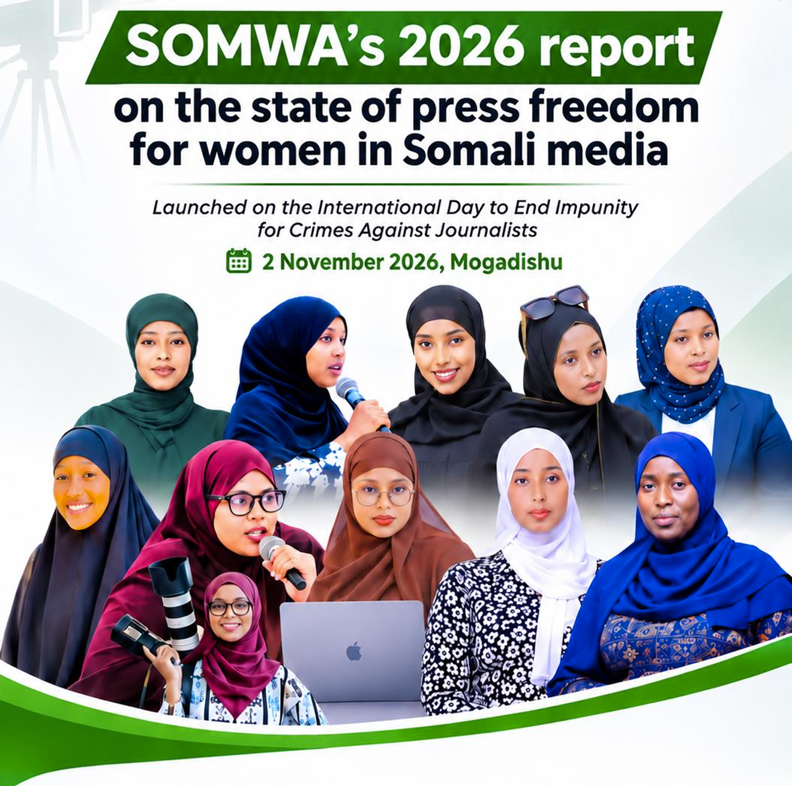
MOGADISHU, SOMALIA – 5 November 2026: The Somali Media Women Association (SOMWA) has launched its 2026 report on the state of press freedom for women in Somali media, documenting 96 incidents affecting journalists between November 2025 and October 2026 and calling for stronger protection, accountability and urgent legal reforms.
The report, titled “Strengthening Collective Voice, Protection, and Opportunities for Somali Women Journalists,” under the Women Economic & Social Empowerment Making a Difference: was launched in Mogadishu on the International Day to End Impunity for Crimes Against Journalists. It provides an account of the growing threats facing Somali journalists, including arbitrary arrests, detention, physical assaults, abductions, equipment confiscation and increasingly sophisticated digital attacks.
Based on SOMWA’s monitoring and documentation, the report highlights a concerning pattern of violations affecting journalists across different regions of Somalia. Arrests and detention accounted for 33 documented incidents, while physical assaults accounted for 17, abductions for 13, equipment seizures for 12 and digital attacks for 21.
Digital attacks emerge as a growing threat to press freedom
One of the report’s key findings is the growing use of digital platforms and reporting mechanisms to target journalists and media organisations.
SOMWA documented 21 digital attacks during the reporting period, including coordinated mass reporting, fraudulent copyright complaints and the misuse of Facebook’s account memorialisation process to target living journalists.
These tactics have resulted in the removal or restriction of journalists’ Facebook pages and accounts, disrupting their professional activities, audience engagement and access to important communication platforms.
The report documents cases involving journalists and media figures with audiences ranging from hundreds of thousands to millions of followers. It also highlights the case of journalist Munasar Mohamed, whose Facebook account was targeted through a fraudulent memorialisation request, alongside attacks affecting Gaylan Media.
SOMWA warns that digital attacks are increasingly becoming another means of silencing journalists, with significant consequences for independent reporting and freedom of expression.
The report calls on Meta to establish a dedicated and accessible review mechanism for verified journalists and media organisations whose accounts are disabled or restricted, with human review and timely responses. It also urges the platform to take action against repeated fraudulent copyright claims.
Women journalists face additional risks
The report highlights the particular challenges faced by women journalists, who experience threats beyond those affecting the wider media profession.
Since 2023, SOMWA has documented 79 cases involving gender-based harassment, online abuse and targeted defamation against women journalists.
Women reporting on political and public affairs frequently face attacks directed at their character and personal lives rather than their professional work. Such abuse can extend into their families and communities, creating additional pressure to withdraw from public reporting.
The report also documents incidents involving women journalists who were arrested, assaulted or detained while carrying out their professional responsibilities.
Among the cases highlighted is Goobjoog Media journalist Rowda Hassan Taakilo, who was detained in Deyniile, Mogadishu, on 7 May 2026. For a period following her detention, her whereabouts remained unknown to her colleagues and SOMWA.
Another case concerns journalist Suways Gacayte, who was arrested by Puntland security forces on 2 July 2026 and held at Garowe Central Prison for thirteen days before being released on bail on 15 July.
The report also documents the assault of Shabelle Radio and Television journalist Shukri Abdi by mobile police officers while covering a protest in Mogadishu in August 2026.
These cases demonstrate the difficult and often dangerous environment in which Somali journalists, particularly women, continue to work.
SOMWA calls for accountability and legal reforms
The report identifies significant gaps between the legal protections available to journalists and the realities they face in carrying out their work.
Although Somalia’s Constitution guarantees freedom of expression and freedom of the press under Article 18, and the National Media Law of 2016 provides a framework for media operations, journalists continue to experience violations without effective accountability.
SOMWA calls on the Federal Government of Somalia to establish an independent mechanism for receiving and investigating complaints against security agencies, issue clear directives protecting journalists covering news events, and introduce legislation addressing digital extortion and the abuse of online reporting mechanisms.
The report also urges regional administrations to ensure that journalists detained in connection with their work are brought before courts promptly and that clear protocols are established to protect journalists covering public events and protests.
The international community is encouraged to make press freedom a regular part of its engagement with Somali authorities and support practical protection measures for women journalists, including legal assistance, safety training and psychosocial support.
From documenting violations to building protection
Beyond documenting violations, the report highlights SOMWA’s efforts to strengthen the collective voice, protection and professional opportunities of women journalists across Somalia.
Through its project, Strengthening Collective Voice, Protection and Opportunities for Somali Women Journalists, implemented in partnership with the United Nations Development Programme (UNDP) and funded by the European Union, SOMWA is undertaking a national mapping of women journalists across Somalia.
The initiative aims to identify and connect at least 300 women journalists and media professionals across Banadir and the Federal Member States, documenting their professional backgrounds, working conditions, needs and security challenges.
The project also includes the development of a secure national database designed to strengthen professional networks, improve coordination and support more effective protection mechanisms.
The database incorporates a three-tier access structure to safeguard journalists’ personal information, with sensitive security-related information accessible only to authorised SOMWA administrators.
A call for collective responsibility
Speaking in the report, SOMWA Executive Director Maryan Seylac emphasised the importance of moving beyond documenting violations towards establishing practical protection mechanisms.
She noted that the organisation is working to ensure that women journalists are connected, visible and supported before they face a crisis, rather than responding only after incidents occur.
The report serves as a call to action for government institutions, security agencies, digital platforms, media organisations, development partners and the international community to take concrete steps towards protecting journalists and ending impunity.
As Somalia continues to strengthen its media landscape, the safety and freedom of journalists remain essential to accountability, public participation and democratic development.
SOMWA reiterates that journalists must be able to report without fear of arrest, violence, intimidation or digital censorship. Crimes against journalists must be investigated, perpetrators held accountable, and women journalists given the protection and opportunities they deserve.
Silence is not an option.